
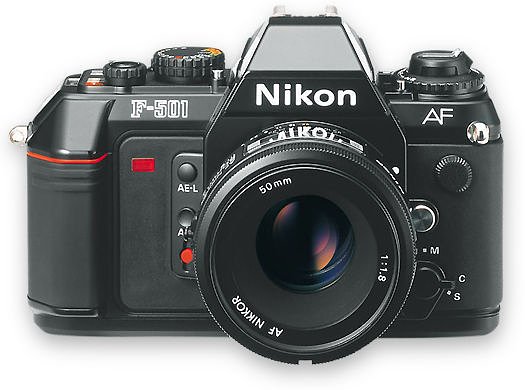
Nikon Cameras F-501
1986, April
The Nikon F-501 (sold in North America as the N2020) was the first successful autofocus SLR camera sold by the Nikon Corporation beginning in April, 1986. A nearly identical, albeit manual focus version, called the Nikon F-301 (N2000 in North America) was also available. Subsequent models in the consumer line included the Nikon F-401, Nikon F-601, and Nikon F-801 / F-801s.
Features
The F-501 is a 35 mm single-lens reflex camera with automatic film loading and advance, almost a first for Nikon (the F-301 was their first SLR to feature this). The built-in motor drive provides single (one exposure and frame advance per shutter button press) or continuous (shutter will fire and film will advance so long as the shutter button is depressed) modes. Maximum film advance speed is 2.5 frames per second (frame/s) on continuous mode, but can be as slow as 1.4 frames/s depending on the status of the focus/exposure locks. Rewind is accomplished manually by a familiar rewind knob which doubled as a release for the back. The F-501 is powered by four AAA batteries housed in the bottom of the camera body, although it can utilize AA sized batteries with an optional attachment (MB-3).
The F-501 uses a through-the-lens (TTL) "passive" phase-detection autofocus method for establishing focus. Unlike active systems, which set approximate focus based on distance to the subject, the "passive" system uses a CCD to "see" the focus subject and focus in a manner similar to a human operator. This method is more precise than the active method, but requires more light to function. The F-501 has two focus modes available, single, in which focus is established and does not change so long as the operator holds down lightly on the shutter button, and continuous, in which the lens continuously re-focuses on whatever is in the focus area.
The F-501 is one of only three cameras, the others being the F3-AF and the F4, which can autofocus with the two AF-NIKKOR lenses introduced for the F3-AF, the 80 mm 1:2.8 and the 200 mm 1:3.5. Unlike other AF-NIKKOR lenses use a focus motor in the lens, rather than a mechanical coupling from a motor in the camera. AF-I, AF-S and AF-P Nikkor lenses also use a focus motor in the lens, but are not compatible with the short-lived system introduced with the F3-AF.
The F-501 can be set for auto exposure, "hi-speed" auto exposure, "dual" auto-exposure (with AI-S type lenses) which switches between regular auto exposure and hi-speed autoexposure based on the lens attached, aperture priority, or full manual exposure modes, which allow the user to set both the aperture and shutter speeds. The shutter speed and auto-exposure modes are set by the use of a dial on the top of the camera, while the aperture ring on the lens is used for aperture control. The "hi-speed" auto-exposure tends to favor higher shutter speeds and wider aperture settings than the "normal" auto exposure mode, while the "dual" mode offers "normal" auto-exposure with lenses at focal lengths less than 135 mm and "hi-speed" auto-exposure if a lens is longer than 135 mm.
The F-501 supports TTL flash exposures with a wide range of Nikon flashes. The Nikon SB-20 flash was especially designed for this camera.